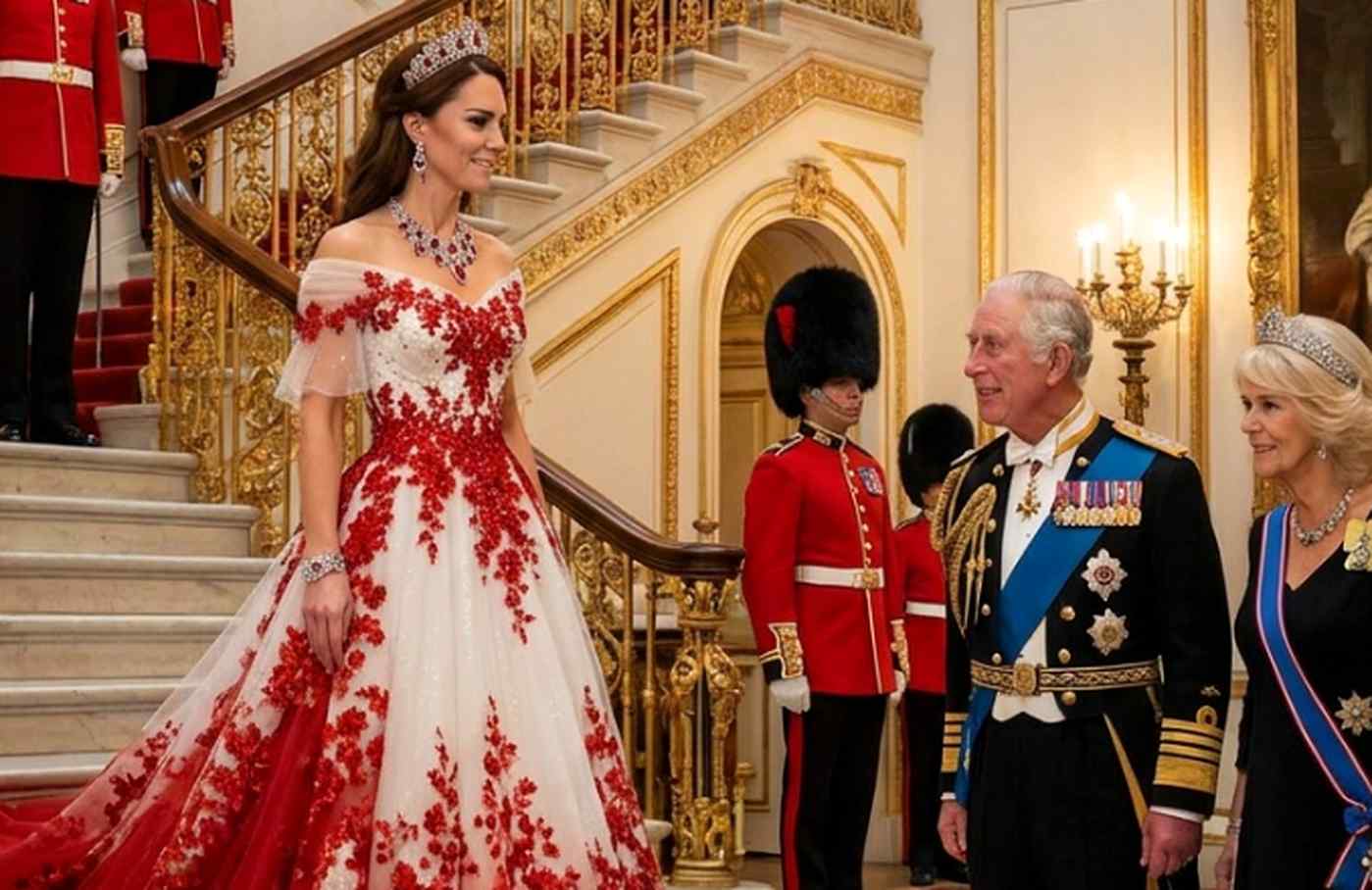
The Grand Staircase and the Moment That Held the Room
The staircase had seen centuries of formal entrances. Gilded balustrades, towering portraits, the soft glow of chandeliers reflecting off marble — everything about the setting was designed to impress. Guards in scarlet tunics stood at measured intervals along the steps, their black bearskins motionless. The air itself seemed to carry the weight of history.
Then Princess Catherine began her descent.

She wore a dramatic off-the-shoulder gown that moved from pure white into deep crimson, the skirt blooming with intricate floral embroidery that caught the light with every step. A tiara sat perfectly in place. The effect was striking — elegant, modern, and impossible to ignore. As she moved downward, the fabric trailed behind her like a carefully controlled cascade of colour against the pale stone.
At the foot of the stairs, King Charles and Queen Camilla waited.
Charles turned toward his daughter-in-law with an expression that some later described as unusually attentive. He watched her approach with a focus that went beyond ordinary protocol. Camilla stood slightly to his side, her own dark gown and sapphire-blue sash forming a quiet contrast to the vivid red and white moving toward them. The three figures formed a brief, motionless tableau as Catherine reached the lower steps.
In that short interval the atmosphere in the hall seemed to tighten. Conversations nearby softened. Eyes moved between the descending princess and the couple receiving her. Whether the shift was simply the natural pause that accompanies a striking entrance or something more layered, those present felt it. Grand royal settings have a way of amplifying small currents of feeling, and tonight the currents were noticeable.
Catherine continued forward with composed grace. Her smile was polite and measured. Charles offered a warm greeting, the kind of understated courtesy he has long practised. Camilla’s expression remained serene, the practised calm of someone accustomed to public scrutiny. On the surface everything remained correct. Yet the visual contrast — the brilliant gown against the darker formalwear, the younger woman descending while the older generation waited below — invited interpretation.
Royal gatherings of this scale are rarely simple. History, hierarchy, personality and the inevitable weight of public expectation all occupy the same space. A single glance held a moment too long, a gesture of particular attentiveness, or the simple fact of who stands where can be read as significance even when none is intended. On this evening the combination of the dramatic entrance and the quiet reception created exactly that kind of ambiguity.

The Guards remained perfectly still. The portraits of earlier generations looked down from the walls. Chandeliers continued to throw their soft light across gold leaf and polished stone. And in the centre of it all, three members of the same family completed a formal greeting that somehow felt charged with more than ceremony.
Catherine’s gown remained the visual focus long after she reached the bottom of the stairs. The transition from white to red, the delicate off-shoulder line, the way the embroidery seemed to shift with movement — it was the kind of appearance that photographs would carry far beyond the evening itself. Yet the lasting impression for many who were present was not only the dress. It was the brief, almost tangible pause that settled over the hall as she came into view of the King and Queen.
In the end the moment passed, as these moments always do. Greetings were exchanged. The party moved forward. The grand staircase returned to its role as magnificent backdrop rather than stage. But for a few seconds the room had registered a subtle change in temperature — elegant, formal, and just ambiguous enough to leave people wondering what, if anything, had truly passed between the figures at the centre of the scene.
One striking entrance. One carefully watched reception. And a grand staircase that, for a short time, felt a little colder than the chandeliers suggested.
